Building an inspection plan for your own properties
From asset register to deadline list in five steps: record your inventory, assign obligations, calculate due dates, define responsibilities and keep evidence.
Hoang Nguyen · 27 September 2026 · 6 min read
Take a metalworking company with three workshops and an office building, for example. The electrical inspection happens when the network operator writes. The fire extinguishers are checked by the firm that supplied them. The heating is looked after by the service technician, the doors by nobody in particular, and nobody has ever thought of an obligation for the showers in the changing room. Each inspection is dealt with on its own, somehow. Nobody has an overview.
An inspection plan changes that. It is simply a complete list: which asset, which obligation, which interval, who inspects, when it was last done, when it is next due. That sounds simple, and it is — if you proceed in the right order.
This article takes you from the asset register to the deadline list in five steps.
Step 1: Record your inventory
An inspection plan does not start with the obligations, but with the assets. If you start with the obligations, you inspect what you know and overlook what you don't know.
So start from the building: property, building, floor, room, asset. A walk-round with a plan and a phone brings to light what appears on no list. Pay particular attention to these groups:
- Electrical: main distribution board and sub-distribution boards, photovoltaics, charging stations, lightning protection
- Heating: oil and gas burners, tank installations, heat pumps
- Fire protection: fire doors and gates, portable fire extinguishers, fire-fighting points, fire alarm system, emergency lighting
- Building services: ventilation, refrigeration systems, lifts, hot water and showers
- Work equipment: doors and gates, ladders, shelving, forklifts, cranes, lifting platforms
- Building envelope: roof, fall protection, anchor points
Every asset gets a unique designation and a location. "Gate 3, Hall 2, Goods delivery" is unambiguous; "the big gate" is not.
Step 2: Assign obligations to each asset
Inspection obligations come from several sources: federal law, cantonal law, the VKF fire protection regulations, manufacturer specifications and contracts with insurers or service providers. For most assets there is a governing basis. Some examples:
| Asset | Basis | Interval |
|---|---|---|
| Electrical installation | NIV Art. 36 and annex | 1 to 20 years depending on use, for example 5 years for industrial and large commercial premises |
| Oil burner | Luftreinhalte-Verordnung Art. 13 | Emissions measurement generally every 2 years; gas burners up to 1 MW every 4 years |
| Tank installation requiring a permit | Gewässerschutzverordnung Art. 32a | External visual inspection every 10 years |
| Portable fire extinguishers | VKF guideline 18-15 | Maintenance according to manufacturer specifications |
| Fire alarm system | VKF guideline 20-15 | periodic, cycle depending on type, size and use |
| Work equipment such as doors and gates, ladders, forklifts | VUV Art. 32b | according to manufacturer specifications, maintenance documented |
The table is an extract. You will find more on two areas in the articles on electrical inspection under the NIV and on fire protection in the workplace.
Two things stand out. First, many regulations do not give a fixed figure, but say "periodic" or "according to manufacturer specifications". In that case the specific interval from the operating instructions, the maintenance contract or the authority's requirement belongs in the plan — stating where it comes from. Second, the cantons regulate a lot themselves, from burner inspections to chimney sweeping. Enforcement of the Luftreinhalte-Verordnung, for example, lies with the cantons; the interval and the inspecting body can therefore differ depending on location.
Step 3: Set the interval and next due date
The next due date follows from the last time the inspection was carried out and the interval. For this you need the date of the last inspection for each asset — from the last report, the safety certificate or the sticker on the device.
Three rules prevent typical mistakes:
- Don't guess: If the last date is unknown, the inspection is due — now. An estimated date produces a deadline that nobody can justify.
- Count from completion: The next deadline starts on the day the inspection actually took place, not the day it was planned for.
- Keep missed deadlines visible: If an inspection is done too late, the gap stays in the history. A plan that silently skips missed deadlines creates exactly the gap that nobody can explain when a claim arises.
Also allow for lead time. An electrical inspection needs months for quotation, inspection and rectification of defects; a visual inspection of the fire doors takes an hour.
Step 4: Define responsibilities
Every obligation involves three roles: Who orders the inspection? Who accompanies it on site? Who carries it out? These are often three different people or companies, and often only the third is known.
For external inspections, record the company and the contract. Where the law requires it, ensure independence: The periodic electrical inspection must not be carried out by anyone who has worked on the installation (NIV Art. 31). And for internal inspections, define who does them and who deputises when that person is absent.
Check what existing maintenance contracts actually cover. A "fire protection" contract may include the extinguishers but not the fire doors. And a service contract for the heating does not replace the burner inspection under the Luftreinhalte-Verordnung: that is monitored by the authority, which carries it out itself or has it carried out.
Step 5: Carry out, document, update
An inspection plan only stays alive if it is updated after every inspection:
- After the inspection, file the report with the asset, not in a pile.
- Record any defects found immediately as a work order and document their rectification as well.
- Enter the date of completion; this gives you the next due date.
- Once a year, review the whole plan: new assets, decommissioned assets, changed regulations, new contracts.
Rule of thumb: First the inventory, then the obligations, then the deadlines. An inspection plan is complete when every asset is in it — not when every known obligation is in it.
This article is general information and not legal advice. In individual cases, the regulations of the canton and the requirements of the competent body apply.
How Fristo helps
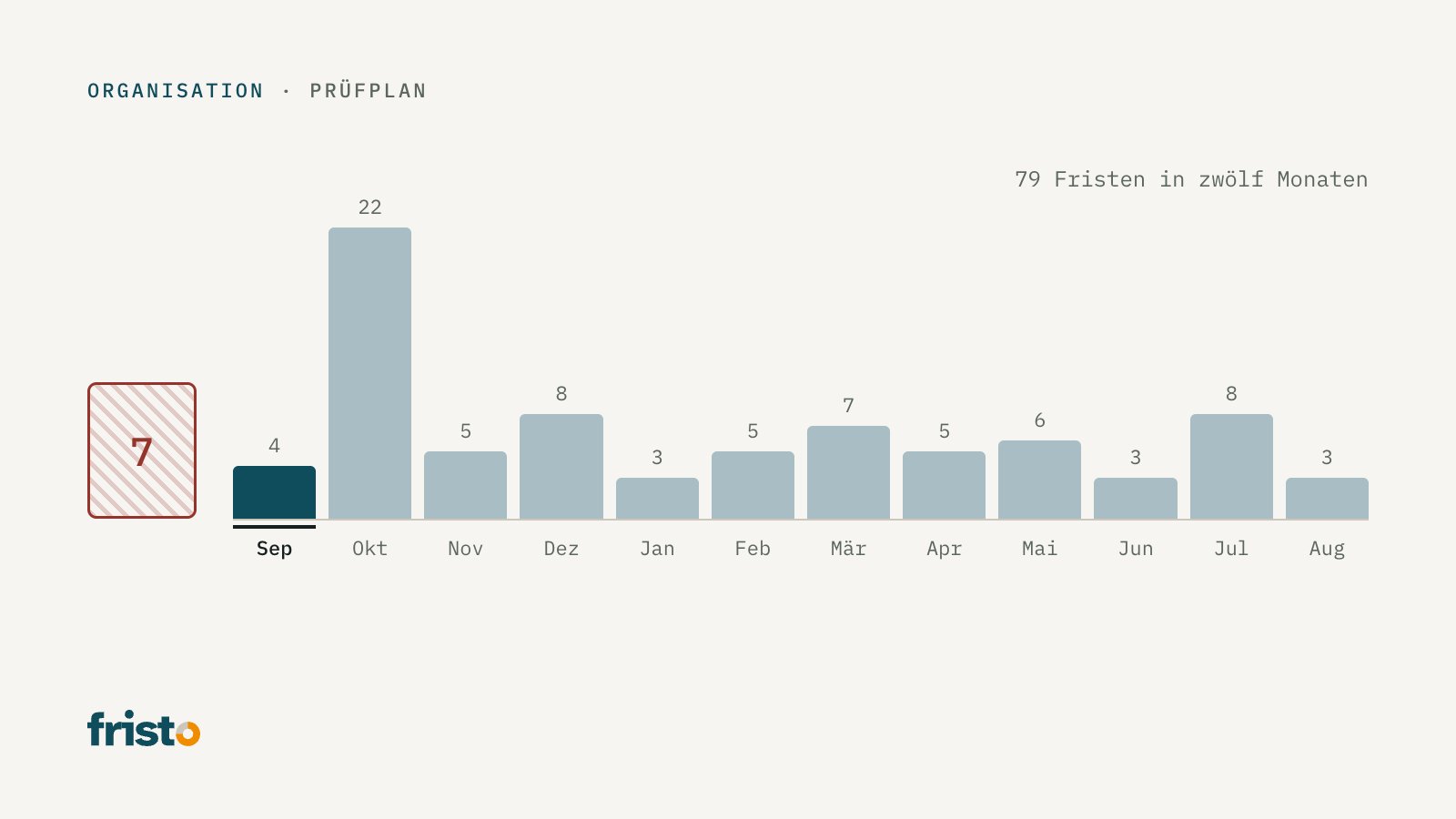
For Switzerland, Fristo provides 35 inspection templates with legal basis, interval and source, and suggests the suitable ones for the assets you have recorded — as a suggestion, not as legal advice. An appointment is created only once you have confirmed that the template applies to your business, and the due date is derived from the date of the last inspection, which you enter when adopting it. After that, every deadline counts from the actual completion, missed deadlines stay visible, and the annual timeline shows in which month inspections cluster.
Sources
- Verordnung über elektrische Niederspannungsinstallationen (NIV), SR 734.27, Art. 31, 36 and annex — Federal Chancellery, Fedlex: fedlex.admin.ch/eli/cc/2002/22/de
- Luftreinhalte-Verordnung (LRV), SR 814.318.142.1, Art. 13 — Federal Chancellery, Fedlex: fedlex.admin.ch/eli/cc/1986/208_208_208/de
- Gewässerschutzverordnung (GSchV), SR 814.201, Art. 32a — Federal Chancellery, Fedlex: fedlex.admin.ch/eli/cc/1998/2863_2863_2863/de
- Verordnung über die Verhütung von Unfällen und Berufskrankheiten (VUV), SR 832.30, Art. 32b — Federal Chancellery, Fedlex: fedlex.admin.ch/eli/cc/1983/1968_1968_1968/de
- Fire protection guidelines 18-15 "Löscheinrichtungen" (extinguishing equipment) and 20-15 "Brandmeldeanlagen" (fire alarm systems) — Vereinigung Kantonaler Feuerversicherungen VKF: bsvonline.ch