When the caretaker leaves: keeping knowledge of your installations in the organisation
Handover, documents on site, contracts and notice periods: how an organisation records what only one person knew until now, before that person leaves.
Hoang Nguyen · 12 October 2026 · 6 min read
At the end of March, the caretaker retires. He spent twenty-two years with the organisation, and in that time he has remembered things that are written down nowhere: that the fire door on the second floor only closes if you lift it. That the company for the roller doors comes every April without anyone phoning. That the key to the boiler room hangs on the board behind the workshop door. And that the contract with the ventilation company would have to be cancelled by the end of June if you want to switch.
His successor starts on 1 April. The handover takes two afternoons, one of which is lost to a heating fault. What is missing afterwards, the organisation does not notice straight away. It notices in autumn, when the fire authority asks for the latest test report on the fire alarm system and nobody knows which folder it is in.
This article shows what knowledge is lost when staff change, how to prepare the handover before it is needed, and why documents belong with the installation and not in one person's head.
What exists only in people's heads
An experienced caretaker's knowledge can be sorted into five groups. Each group has its own place where it needs to be recorded:
- Inventory: Which installations exist, where they are and what they are called. "The compressor at the back on the left" is not a location for the successor.
- Obligations and deadlines: Which installation must be inspected when, by whom, and when this last happened.
- Contracts and contacts: Which company is responsible for what, whom to call there and by when a contract can be cancelled.
- Quirks: The door that sticks. The filter that has to be changed every three months instead of every six because the hall is dusty. The heating that has to be acknowledged manually after a power failure.
- Keys and access: Keys, codes for gates and the alarm system, access to suppliers' web portals.
The first three groups are data. They can be captured in a list or a system and stay there when the person leaves. The fourth group is experience. It can only be saved if someone writes it as a note on the installation concerned. The fifth belongs in a key register and a password manager, not in a list of installations.
Prepare the handover before it is needed
The time for a handover is short. An employee who resigns after ten years of service has, under the Code of Obligations, a notice period of three months; in the first year of service it is one (OR Art. 335c; differing written agreements are possible). After holidays and day-to-day work, often only a few days remain for what really needs weeks. And in the event of an accident or long illness, there is no handover at all.
That is why recording knowledge belongs in daily work, not at the end of an employment relationship. A walk-round of each building, once a year, with a second person has proved effective:
- Go through room by room and record each installation with its designation, number and location. A photo of the rating plate saves searching later for the manufacturer and year of construction.
- For each installation, note which inspection or maintenance it needs, who carries it out and when it last took place.
- Write quirks as a short note on the installation, not in a separate notebook.
- Record outstanding items immediately as a work order, instead of dealing with them "next time".
How such a walk-round becomes a complete inspection plan is described in the article Building an inspection plan for your own properties.
Incidentally, the Code of Obligations contains an obligation that helps here: employees hand over to the employer what they produce in the course of their work (OR Art. 321b para. 2), and when the employment relationship ends, each party hands over to the other what it has received on the other's account (OR Art. 339a). Even a maintenance list kept on a private laptop must therefore be handed over. It is easier if it is never created there in the first place.
Documents belong with the installation
In many organisations, the paperwork sits in a folder in the plant room: operating instructions, diagrams, test reports, quotations. As long as one person knows which folder contains what, this works. Afterwards the folder becomes an archive that nobody searches any more.
Two rules make documents independent of individuals:
- Every document has a place in the inventory. The test report for the emergency lighting is attached to the emergency lighting, the floor plan to the storey, the maintenance contract to the company and the installations it covers.
- Proof is created with the work. Whoever completes an inspection files the report in the same step. A pile marked "still to be filed" is a gap that is noticed at the latest during an inspection.
For work equipment such as ladders, gates or forklifts, the Ordinance on the Prevention of Accidents and Occupational Diseases expressly requires that maintenance be documented (VUV Art. 32b). A check that has not been written down cannot be proven after a change of staff.
Contracts and notice periods
Maintenance contracts often continue quietly. Some renew automatically for a year if they are not cancelled in time. The deadline is in the contract, not in the law. Whoever concluded the contract knows it. Whoever takes it over often discovers it too late.
So record four details for every contract:
| Detail | Example |
|---|---|
| Company and contact person | Tore-Service AG, Ms Keller, direct dial |
| What the contract covers | all power-operated gates in halls 1 and 2 |
| Term and renewal | until 31.12., renews for one year |
| Cancellable until | 30.09. (three months before expiry) |
The details in the example are invented. The last row is the decisive one: the date by which the contract can be cancelled belongs as an appointment in the organisation's calendar, not in one person's.
Responsibilities instead of people
A list that says "Hans" against every installation is out of date on the day he leaves. It is more robust to assign tasks to a role or a group ("Caretaking", "Technical Hall 2", "External electrician") and to assign people to that role. When someone changes, one assignment changes, not two hundred entries.
Cover arrangements are just as important. When the responsible person is on holiday, someone else must be able to see what falls due this week. And when someone leaves the organisation, their access to systems and portals is blocked on their last working day, after their open orders have been reallocated, not before.
Rule of thumb: What only one person knows, the organisation does not know. Record installations, deadlines, contracts and quirks where the successor will find them on the first day.
This article is general information and not legal advice. In individual cases, the regulations and the requirements of the competent authority apply, as does your employment contract.
How Fristo helps
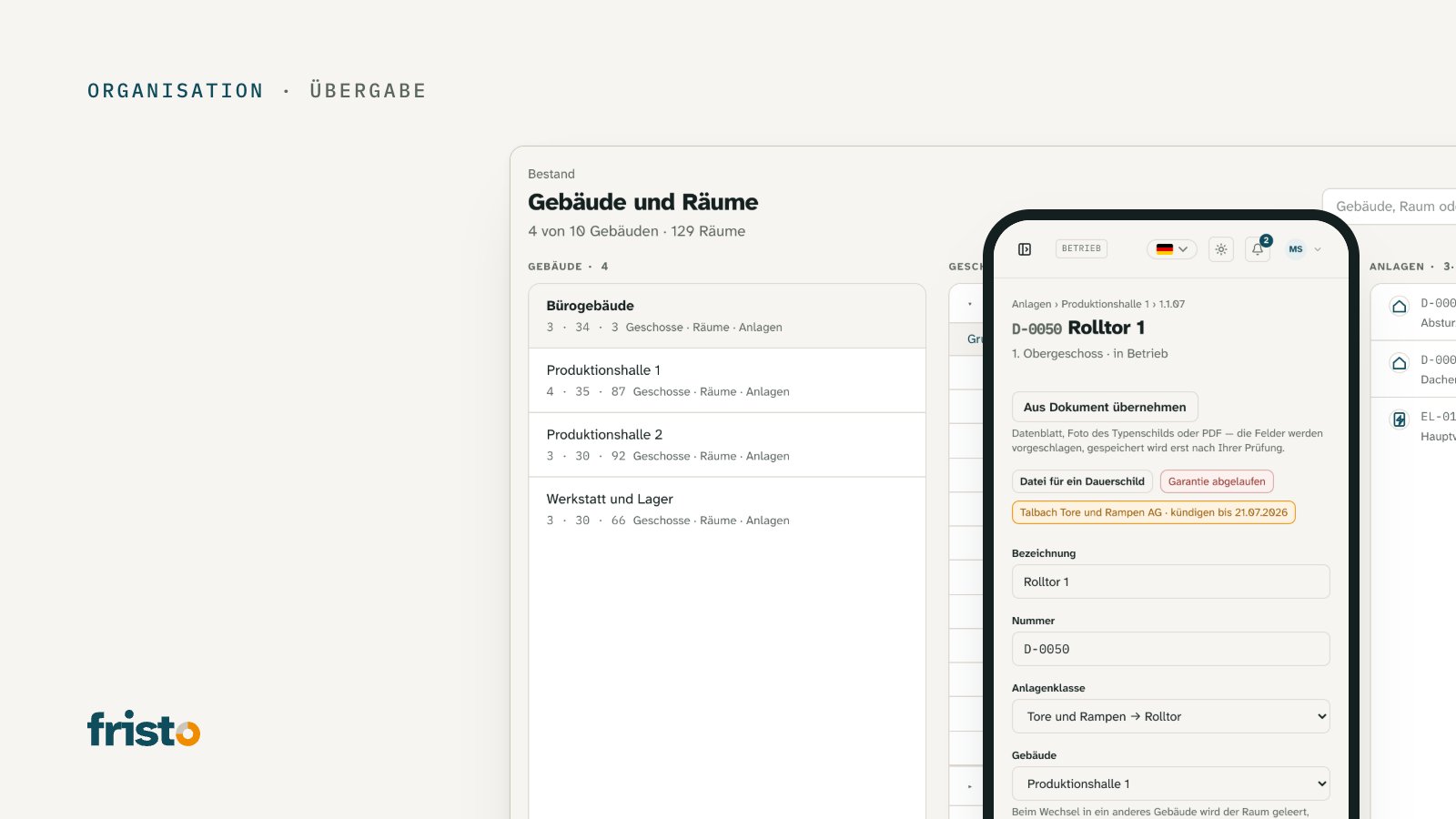
In Fristo, knowledge is tied to the inventory, not to a person: every installation has a location, number and notes, and plans and inspection reports are stored as documents on the building, the installation or the work order. Maintenance contracts appear with their term and notice period in a list sorted by cancellation date, and each affected installation shows "cancel by" with a date. Work orders can be assigned to a group instead of a person; anyone who leaves the organisation is deactivated and is immediately signed out of all sessions.
Sources
- Code of Obligations (OR), SR 220, Art. 321b, 335c and 339a — Federal Chancellery, Fedlex: fedlex.admin.ch/eli/cc/27/317_321_377/de
- Ordinance on the Prevention of Accidents and Occupational Diseases (VUV), SR 832.30, Art. 32b — Federal Chancellery, Fedlex: fedlex.admin.ch/eli/cc/1983/1968_1968_1968/de