Liability of the owner of a structure: why proof matters when damage occurs
Under Article 58 OR, the owner of a structure is liable even without fault. Why maintenance and records still matter, and what proof should contain.
Hoang Nguyen · 26 October 2026 · 6 min read
A Friday afternoon at the loading bay. The sectional door comes down even though the delivery van is still underneath it; the safety device did not respond. The driver is injured in the shoulder and the vehicle is damaged. Two weeks later a letter arrives from his insurer with three questions: When was the door last inspected? By whom? Is there a report?
The answers exist somewhere — in the caretaker's head, in a folder, at the door company. Whether they reach the table promptly and in full determines how well the business can explain its position.
This article explains in outline what the liability of the owner of a structure under the Code of Obligations is, why maintenance and the records of it play such a large part, and what useful proof contains. It does not replace legal advice in an individual case.
What liability of the owner of a structure is
Article 58 of the Code of Obligations (OR), paragraph 1, reads: "The owner of a building or other structure must compensate for the damage that it causes as a result of defective design or construction or of inadequate maintenance."
According to the Swiss Council for Accident Prevention (BFU), a structure is a permanently installed, man-made facility connected to the ground — such as roads and buildings. A structure is considered defective if it is not sufficiently safe for its intended use. The law names three causes:
- Defective design: The structure was wrongly planned from the outset.
- Defective construction: Mistakes were made during building.
- Inadequate maintenance: The structure was not sufficiently serviced or kept in good repair.
The liability is strict. According to the BFU, it applies even if the owner is not at fault. The difference is clear when compared with Article 55 OR: there, an employer is liable for their auxiliary staff only if they cannot prove that they exercised all due care. Article 58 provides for no such exculpatory evidence. According to the BFU, even a sign saying "Use at your own risk" does not exclude the liability of the owner of a structure.
Why records still matter
If fault is not relevant, why have reports? Because the question is whether the structure was defective. For maintenance, the BFU examines whether the accident could have been prevented by technically or financially reasonable measures. The BFU expressly gives as an example carrying out and documenting periodic inspections of existing structures and performing necessary maintenance and repair work.
A record can therefore become important in three ways:
- On the question of maintenance: A report shows what was inspected when and what the outcome was. Without a report, only the recollection of individuals remains.
- For recourse: Article 58 paragraph 2 OR reserves the owner's right of recourse against others who are responsible to them for the damage — such as a company that has taken on maintenance by contract. This requires the contract and proof of what it should have done and what it did.
- Towards the authorities: Several regulations expressly require documentation. The Ordinance on the Prevention of Accidents and Occupational Diseases requires the maintenance of work equipment to be documented (VUV Art. 32b). VKF Fire Protection Guideline 12-15 requires inspections and maintenance of fire protection equipment to be documented in writing.
How long records remain important
The Code of Obligations does not specify a general retention period for inspection reports. A guide is provided by the limitation periods for damages in tort in Article 60 OR: three years from knowledge of the damage and of the person liable, but in any case ten years from the harmful conduct. In cases of death or bodily injury, the absolute period is twenty years.
Some regulations are even clearer. The Low Voltage Installations Ordinance requires the technical documents of an electrical installation to be kept throughout its entire service life (NIV Art. 5). Fire Protection Guideline 11-15 requires fire protection documents to be kept until a building has been fully dismantled. An inspection report does not belong in the waste paper after five years.
What useful proof contains
Proof is more than an invoice marked "Door maintenance". It answers six questions:
| Question | Example |
|---|---|
| Which installation? | Sectional door, loading bay, number T-03, Hall 2 |
| What was inspected? | Safety devices, emergency release, springs, guide rails |
| When? | Date of performance, not of the invoice |
| By whom? | Company, name of the inspector |
| With what result? | in order, or defects found |
| What happened to the defects? | Order, rectified on, by whom |
The details in the example are fictitious. What is outstanding is just as important as what is done. Proof that omits overdue inspections looks complete and is not — and that very gap comes to light anyway when damage occurs.
Typical gaps
- Inspected, but not written down: The ladder was looked at, the door tested — but there is no report.
- The record is held by the company: The service report is in the service provider's portal, not at the business.
- Defect found, rectification outstanding: The report names a defect, but nobody can show that it was rectified.
- Added afterwards: A report written only after the accident does not prove the condition beforehand.
- Installation missing from the register: What is not recorded gets no deadline. How to record each installation with its obligations is shown in the article Building an inspection plan for your own properties.
Rule of thumb: When damage occurs, what counts is not what you know, but what you can show. Inspect, write it down, rectify defects and write that down too — installation by installation.
This article is general information and not legal advice. Whether a structural defect exists in an individual case and who is liable is assessed by insurers and courts according to the specific circumstances; consult a specialist when damage occurs. Otherwise, the cantonal regulations and the requirements of the competent body apply.
How Fristo helps
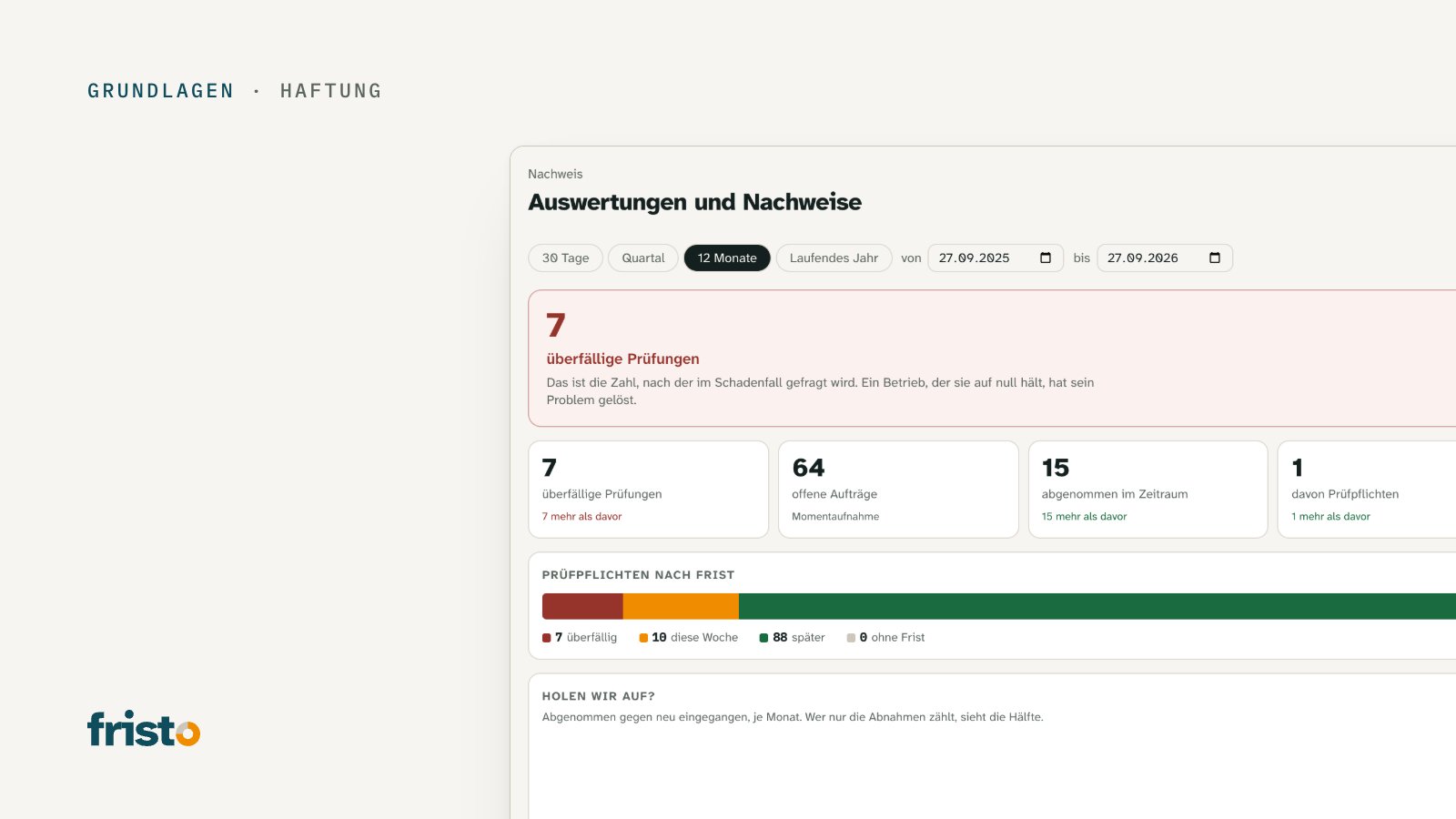
Fristo does not replace an inspection or a specialist, but it records that the inspection took place. Each work order includes the date of execution, the person who carried it out and, if the company attaches it, their report; an approved order cannot be deleted, and the change log shows who changed what and when. The proof per building and period lists the inspections completed and those overdue — the latter cannot be hidden.
Sources
- Code of Obligations (OR), SR 220, Art. 55, 58 and 60 — Federal Chancellery, Fedlex: fedlex.admin.ch/eli/cc/27/317_321_377/de
- What does liability of the owner of a structure mean? — Swiss Council for Accident Prevention BFU: bfu.ch
- Ordinance on the Prevention of Accidents and Occupational Diseases (VUV), SR 832.30, Art. 32b — Federal Chancellery, Fedlex: fedlex.admin.ch/eli/cc/1983/1968_1968_1968/de
- Ordinance on Low Voltage Electrical Installations (NIV), SR 734.27, Art. 5 — Federal Chancellery, Fedlex: fedlex.admin.ch/eli/cc/2002/22/de
- Fire Protection Guidelines 11-15 "Quality assurance in fire protection" and 12-15 "Fire prevention and organisational fire protection" — Association of Cantonal Fire Insurers VKF: bsvonline.ch