Fire protection in the workplace: which systems are inspected regularly
Fire doors, extinguishers, emergency lighting, fire alarm systems: what the VKF guidelines require, where the inspection intervals come from and why the canton has a say.
Hoang Nguyen · 27 September 2026 · 6 min read
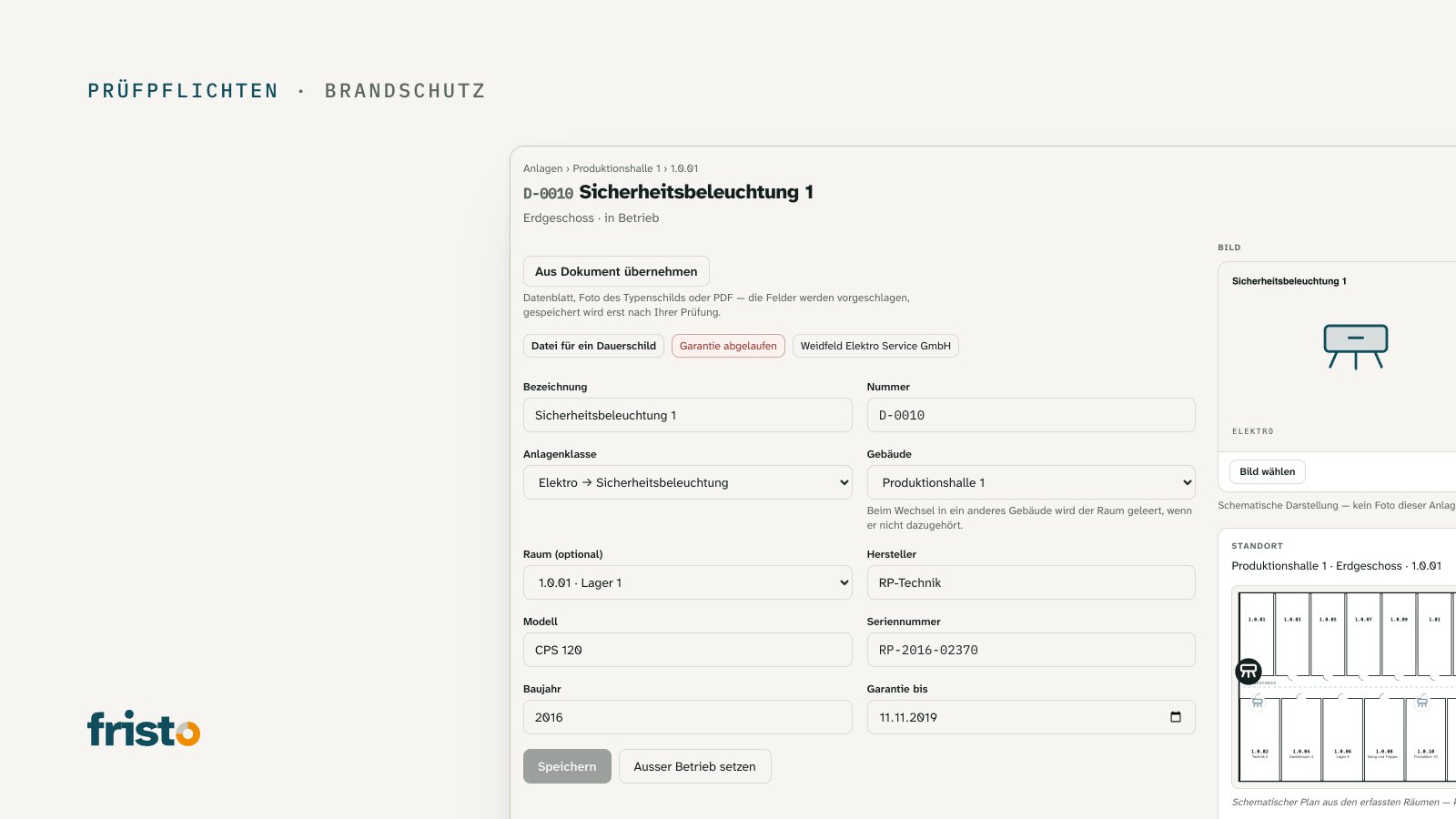
A walk through a production hall on an ordinary Tuesday: the fire door to the warehouse is standing open, held in place by a wooden wedge because the forklift would otherwise have to stop every time. The portable fire extinguisher next to the exit has disappeared behind two pallets. And above the escape door the emergency light is no longer lit — since when, nobody knows.
Only one of these defects is technical. All three only come to light when someone looks regularly and writes down what they see. That is exactly what the Swiss fire protection regulations require: that fire protection equipment is operational at all times and that the business can prove it.
This article shows which equipment must be checked regularly, what the regulations say about it — and why the specific intervals are often not found in the regulations, but with the manufacturer and the canton.
Who makes the rules and why the canton has a say
The Swiss fire protection regulations are issued by the Association of Cantonal Fire Insurers (VKF): a fire protection standard plus guidelines on individual topics, such as extinguishing equipment or fire alarm systems. They acquire legal force through the Interkantonales Organ Technische Handelshemmnisse (IOTH, the Intercantonal Body for Technical Trade Barriers), which declares them binding for all cantons. The basis for this is an agreement between the cantons, the Interkantonale Vereinbarung zum Abbau technischer Handelshemmnisse (IVTH).
The regulations are therefore the same throughout Switzerland. However, each canton handles enforcement itself, through its fire protection authority — in many places this is the cantonal building insurance. It monitors compliance with the regulations and can inspect buildings and installations (Brandschutznorm Art. 60). How often it does so and which businesses carry out their own inspections is determined by the canton.
One example is the canton of Zurich. Under a directive of the building insurance, commercial and industrial businesses with an increased risk to persons, for instance, are inspected by the municipal fire police every four years. Industrial and commercial businesses without an increased risk to persons, office and administration buildings and residential buildings, by contrast, are subject to self-inspection. There it is up to the owners or users to check safety periodically and to rectify defects. Responsibilities must be recorded in writing, and inspections and maintenance must be documented in writing. Other cantons regulate this differently; the duty to document applies everywhere.
The regulations in force today date essentially from 2015. The VKF is working on a complete revision; as things stand, the new fire protection regulations are due to come into force in autumn 2027.
The basic duty: keep equipment in working order and write it down
The Brandschutznorm obliges owners and users to maintain fire protection equipment and building services installations as intended and to keep them operational at all times (Art. 20). Guideline 12-15 "Fire prevention and organisational fire protection" turns this into a concrete duty: operational readiness must be ensured through regular inspections and maintenance and documented in writing (section 4.2).
The same guideline requires a business to appoint and train a fire protection safety officer if fire hazards, occupancy, or the nature or size of the business make it necessary (section 4.1). Their tasks include periodic inspections, the maintenance of all fire protection equipment and keeping escape and rescue routes clear.
Which equipment is inspected regularly
The following overview lists the equipment often found in commercial and industrial buildings and what the relevant VKF guideline says about it:
| Equipment | Guideline | What it requires |
|---|---|---|
| Fire doors and gates | 12-15 | regular inspections and maintenance, documented in writing |
| Portable fire extinguishers | 18-15 | in-house readiness checks and periodic maintenance in accordance with the manufacturer's specifications; permanently register delivery, refilling and servicing |
| Emergency lighting and emergency power supply | 17-15 | periodic inspections at defined minimum intervals, including the power supply annually under load and generating sets monthly for operational readiness; a logbook |
| Fire alarm system | 20-15 | periodic inspection, interval depending on type, size and use; maintenance by a specialist company recognised by the VKF; logbook at the control panel |
| Sprinkler system | 19-15 | periodic inspection; maintenance by a specialist company recognised by the VKF; logbook |
| Smoke and heat extraction system | 21-15 | periodic inspection, interval depending on the type of system |
| Fire dampers in ventilation systems | 25-15 | periodic inspection |
The word "periodic" stands out. Most guidelines prescribe that inspections take place, but not at what interval. One exception is guideline 17-15 on emergency lighting, which itself specifies minimum intervals for luminaires, batteries and generating sets.
Where the intervals come from
Where the guideline says "periodic", others fill the gap:
- The manufacturer: For portable fire extinguishers, the guideline expressly refers to the manufacturer's specifications. The maintenance interval is in the manufacturer's documentation.
- The specialist company and its rules: For fire alarm and sprinkler systems, trade associations set out in their own guidelines how maintenance is carried out. The recognised specialist company knows them and follows them.
- The canton: The fire protection authority can impose conditions, for instance in the building permit or after an inspection. Some cantons set inspection intervals in their own directives.
- The maintenance contract: What is agreed there applies to the company — but only if someone checks that it actually turns up.
For the business, this means: the interval for each item of equipment must be gathered once and recorded. Anyone who keeps it in their head will have lost it after the next change of staff.
How to keep track
- Record the equipment: every fire door, every extinguisher, every emergency light, with its location. One list per building is enough to start with.
- Define interval and responsibility: based on the manufacturer's specification, maintenance contract and any conditions imposed by the canton. For each item of equipment it is clear who inspects — own staff or a specialist company.
- Plan walk-rounds: Wedged doors, blocked extinguishers and obstructed escape routes are not found by any maintenance visit, only by a walk-round.
- Keep a logbook: date, result, defects rectified, name. This is the proof the fire protection authority asks for.
- Re-check after alterations: Anyone who opens up a wall or changes a ventilation system is interfering with fire protection. Guideline 12-15 then requires the fire protection concept to be adapted without delay.
Rule of thumb: "Periodic" does not mean "at some point". The guideline requires the inspection, the manufacturer and the canton supply the interval — and the business provides the written proof.
This article is general information and not legal advice. In individual cases, the cantonal regulations and the requirements of the competent fire protection authority apply.
How Fristo helps
For recorded fire doors, portable fire extinguishers, emergency lights, and fire alarm, sprinkler and smoke extraction systems, Fristo suggests the matching inspection templates — with the VKF guideline as the legal basis and a note that the canton specifies them in more detail. An appointment is only created once you have confirmed that the template applies to your business. Every completed inspection is attached to the work order with date, person responsible and report, and a maintenance contract can be assigned to a scope, such as "Fire protection in Hall 1".
Sources
- VKF Fire Protection Regulations 2015: Brandschutznorm (Art. 20, 60, 61) and fire protection guidelines 12-15, 17-15, 18-15, 19-15, 20-15, 21-15 and 25-15 — Association of Cantonal Fire Insurers VKF: bsvonline.ch/de/brandschutzvorschriften/vorschriften-2015
- Revision of the fire protection regulations: immediate measure and further steps — VKF: bsvonline.ch
- Intercantonal Agreement on the Removal of Technical Barriers to Trade (IVTH), Art. 6 — Swiss Conference of Cantonal Directors of Public Works, Planning and Environment BPUK: bpuk.ch, PDF
- Directive 20.02 "Fire police inspections" — Building Insurance of the Canton of Zurich GVZ: gvz.ch, PDF